When Ros Ilyn was diagnosed with Glioblastoma, with a life expectancy of just 3 -18 months, she and husband Gary believed she’d been handed a death sentence.
“Glioblastoma is basically the worst, fastest growing type of brain tumour,” said Gary.
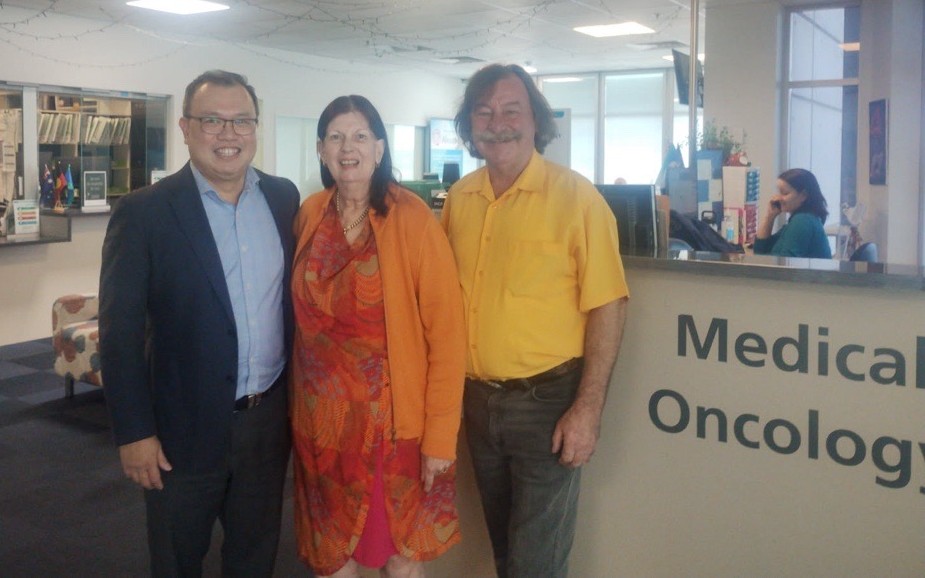
Dr Jeffrey Goh, Ros’s oncologist, is as thrilled as anyone to see her defying expectations.
“The five-year survival rate for glioblastoma is about 5% and yet here Ros is.”
Now, 15 years later, that original devastating prognosis has fuelled the couple’s passion for medical research. Ros participated in a pharmaceutical trial, leading to identification of a key protein that informed her treatment regime.
Dr Goh said evidence of the impact of research is everywhere – as is evidence of the need for even more.
“While I’ve seen a lot of progress being made in some cancers, it’s probably not as fast as we’d like for brain tumours. Prostate cancer, for example, still kills a lot of men, but survival rates have increased so much that in many cases it’s more like a chronic disease than a deadly disease.
“There are important questions to be answered, across the board, with regards to how we deal with the effects of treatment, our options for repurposing drugs to treat cancers, how we make survivorship and quality of life better. Research is the key.”
Research may also hold the key to a cruel twist in Ros’s treatment. In August last year, she began experiencing crippling headaches and suffered a seizure on the way to hospital.
She was eventually diagnosed with SMART syndrome, an acronym for ‘Stroke-like migraine attacks after radiation therapy’. SMART is a rare late complication of brain irradiation with only 100 cases reported in medical literature since it was first described 30 years ago.
The Clear Mountain couple are enthusiastic supporters of the RBWH Foundation, and are deeply thankful to the many people who have treated and cared for Ros over the years.
Gary’s philosophy is that “nobody's got all the answers, and we won’t get them unless we have people asking why and how”.
“Donations to the RBWH Foundation are an investment in progress – funding research that gives people time and hope. What could be more important than that?” said Gary.
It was back in 2010 that the Clear Mountain couple first began to suspect that something wasn’t right with Ros’s health.
“Ros was just feeling a bit funny and forgetting friends' names. Our usual GP was overseas at the time and, luckily, the doctor covering for him didn’t just brush it off as being part of getting older. We did blood tests and a CT scan and, suddenly, the alarm bells went off.”
While further scans revealed no evidence of cancer elsewhere in Ros’s body, surgery confirmed that she had developed a highly aggressive and malignant grade 4 brain tumour (glioblastoma multiforme).
After surgery, Ros had radiotherapy for a month.
“She had to put a mask on and have her head strapped down to a table for 45 minutes of treatment. That was very traumatic for her. Then she started nine months of oral chemo.”
Since then, the couple have been meticulous in their efforts to improve Ros’s general health and boost her immune system.
“She has regular vitamin injections, has had mercury-based fillings removed, and now follows a ketogenic diet and weights-based exercise program.”
About ten years ago, Ros was delivered a further blow when she was diagnosed with temporal lobe epilepsy after a shadow was detected at the back of her brain.
“After another round of chemo, the original tumour - which had been stable since surgery – began to shrink, while the shadow in the back of the brain also appeared to be dissipating,” says Gary.
“At the next MRI, we were booked in to see the oncology registrar. He called Ros’s name, standing there at the door with the biggest smile on his face - you don't often see smiles in oncology wards. He said it was effectively gone.
“Honestly, we don’t have any real answers. All we know is that Ros was dying and now she’s not.”
While life with cancer, and the side-effects of aggressive cancer treatment, is far from easy, Gary said he’s just incredibly grateful that Ros remains by his side.
“We’re so thankful for the work of researchers and teams on the cancer wards – they gave us back the life we thought we’d lost.”
ENDS…