
Love, loss and one baby’s fight for life
Faced with a devastating diagnosis during pregnancy, first-time parents Emily and Andy put their trust in the expert teams at Royal Brisbane and Women’s Hospital (RBWH)
Their care was strengthened by decades of investment in maternal and fetal research by the RBWH Foundation.
Routine pregnancy scans had detected a structural disorder in one of their twins and further testing by RBWH Maternal Fetal Medicine (MFM) confirmed a rare genetic disorder. Their son, Jackson, was failing to develop properly across multiple organ systems and his twin sister, Amelia, was also giving clinicians cause for concern.
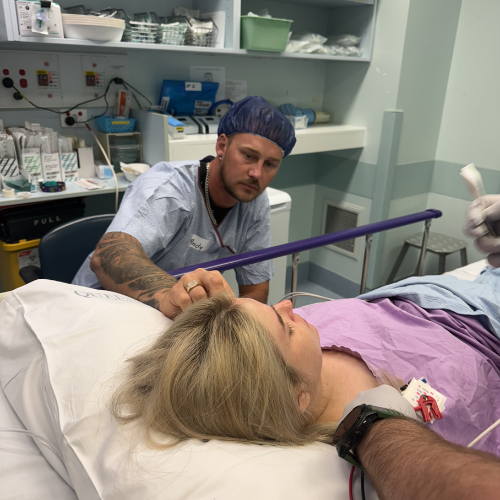
Andy and Emily at RBWH.
Amelia was also giving clinicians cause for concern.
“There were some issues with her growth – she was quite underweight,” Emily said.
“Placenta-cord issues meant that she wasn't getting enough nutrients.
“It's definitely one of those situations that you don't really know how you're going to feel until you're sort of in it. We both really struggled.”
In the midst of uncertainty, the care the couple received became their anchor.
“The team was so dedicated to our care, from the very beginning, that we just felt really, really safe,” Emily said.
“They talked through every procedure that we were going to have, every symptom I would feel, and every possible outcome that could happen.

“We knew that they had the facilities to care for our situation and there was a real sense that they were a team – not a group of individuals just doing their jobs.”
Associate Professor Renuka Sekar - clinical lead for maternal fetal medicine at RBWH, which cares for 10-12% of pregnant women who deliver at RBWH each year – said that ensuring families feel well supported is critical for every member of the team.
“We have a great team here – from admin to our social worker, lovely midwives and sonographers and my colleagues in obstetrics. We work as a family.
"In fact, as we take these mums and dads through this difficult time, we become part of their family,” Associate Professor Sekar said.
Noting that in a pregnancy there are at least two patients with very different needs, Associate Professor Sekar said that “the best care doesn’t happen without research”.
"Babies’ brains, lungs, kidneys, all grow every week, so that is why every week counts. We want to get these babies to the utmost stage of the pregnancy, where we have full development of all these organs. The womb is the best incubator you can have, but it's always a balance.”
It is this careful balance - between science and compassion, research and real-time care - that drives advances in maternal fetal medicine, made possible by RBWH Foundation philanthropic support.
Joy and heartbreak
For Emily - torn between wanting her pregnancy to be over, for the anxious wait to end, and wishing her babies to stay safely in the womb until they were sufficiently developed, those months were excruciatingly difficult.
“When I went into labour, we were really, really excited,” Emily said.
But, as had become familiar on their journey, joy and heartbreak arrived hand in hand. Little Jackson was stillborn.
Teams also gently prepared the couple for the possibility that Amelia might not cry, telling them not to worry – that they’d confirm she was safe and well.
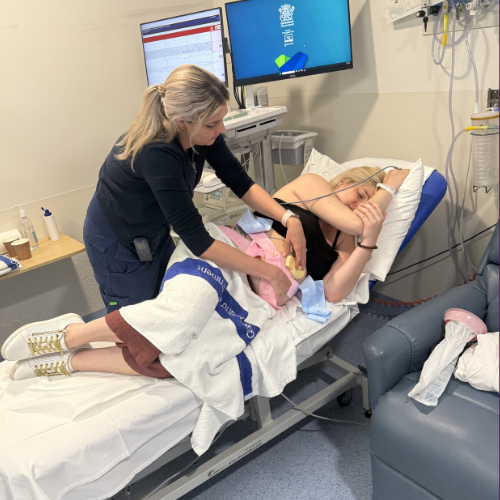
Emily in labor.
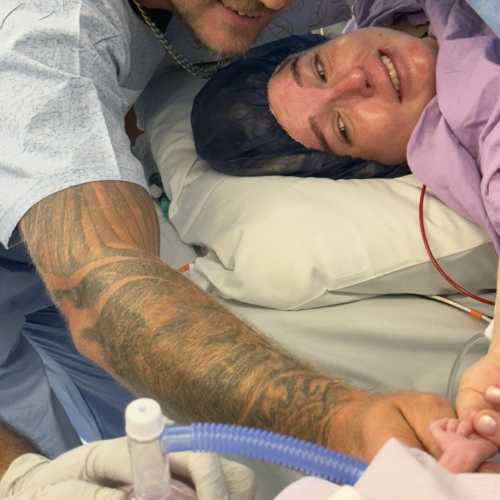
Emily and Andy holding Amelia's hand for the first time.
“The birth was incredibly hard,” Emily said. “It was a struggle to get Amelia out and I hemorrhaged quite a bit of blood during that.”
“But within about 60 seconds, she let out a little cry – I was just so thankful to hear that.”
With their baby daughter safely in the hands of the experts, Emily and Andy processed their enormous loss.
“We finally had our baby girl, but we had to say goodbye to Jackson,” said Emily.
“I don't really know what words you can even use for that kind of pain.”
Incredible compassion
For Andy, who went to an adjoining room to sit with their baby son, it was a day of the highest highs and the lowest lows.
“Seeing Jackson was hard. I just broke down and cried," said Andy
“Then, when Emily came out of recovery they brought him to us, all wrapped up, so we could spend some time with him - touch him for the first and last time.”
In those moments, it was the compassion of clinical teams that left a lasting impact.
They didn’t just care for Emily and Amelia’s physical needs, they cared for Jackson’s memory too, taking photographs and creating handprints and footprints the couple now treasure.
“I just think that was really, really great of them to do because obviously, in that moment, we wouldn't have thought to do any of that, and we would've really regretted not having those things to look back on,” Andy said.
“Their dedication, and the support they provide, is just incredible.”
But while Emily and Andy were grieving one child, another fight was only just beginning: Amelia still needed critical care and expert support, enhanced by RBWH Foundation-funded research and care initiatives - to get her home.
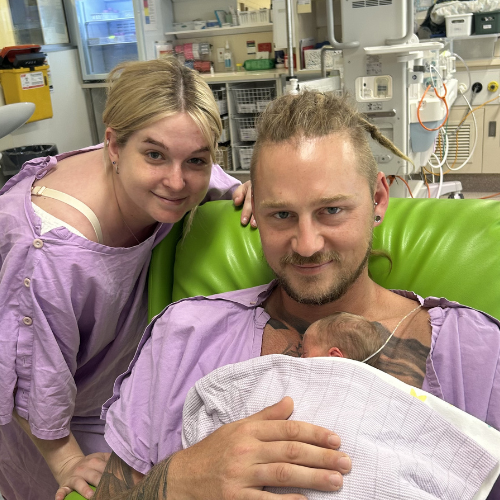
Emily and Andy holding Baby Amelia after birth.